
An Introduction to Road Cycling Racing
In July, the roadsides of the French countryside are packed with spectators. The peloton flashes past, leaving only a fleeting blur. On the television feed, the commentator chases the action: “The break has been caught.” The “rabbit,” as Chinese fans call the escapee, is a rider who went clear; being caught means the peloton has neutralized the attempt.
Many of road racing’s rules live inside this kind of jargon. Unlike football’s offside law, they are rarely explained on their own. They are embedded in the rhythm of the race: who attacks first, who saves energy in the bunch, who only appears in the final 200 metres. Once a viewer understands these terms, the roles and tactical intentions of the riders become legible.
The pages that follow move from the outside in: governance and entry requirements, race types and the shape of a race, classifications and leader’s jerseys, course infrastructure and race vehicles, and finally China’s place in the system.
1. Governance and the Competition System
UCI: The Rule-Maker and Calendar Authority
Road cycling is governed by the Union Cycliste Internationale (UCI). On 14 April 1900, cycling associations from more than ten countries met in Paris and reorganized the former International Cycling Association into the present body; its headquarters are now in Lausanne, Switzerland.

The rules, calendar, team licences and technical regulations for equipment in professional road racing all originate with the UCI. Every level of road race worldwide—whatever its size—must organize and officiate according to UCI regulations; teams and riders rise and fall in the rankings under the same rules.
The UCI’s major events include the Olympic road races, the UCI Road World Championships and the Junior World Championships. It also maintains five continental confederations: Africa, the Americas, Asia, Europe and Oceania.
China’s relationship with the UCI dates to 1939, when the Chinese Cycling Association joined. It withdrew in 1958 and was readmitted in August 1979.
Race Classification: Three Tiers and Six Bands Within the WorldTour
The UCI divides road races into three tiers: the WorldTour, the ProSeries and the Continental circuit. The higher the tier, the stronger the field, the greater the ranking points and the wider the television coverage.
Race codes follow a predictable pattern. The first digit is “1” for a one-day race and “2” for a stage race; the suffix denotes the tier. Thus 1.UWT is a WorldTour one-day race and 2.UWT a WorldTour stage race; women’s events use WWT (1.WWT, 2.WWT). Below these come 1.Pro and 2.Pro; the Continental tier runs from 1.HC and 1.1 to 1.6, with stage races corresponding to 2.HC and 2.1 to 2.6.
Within the WorldTour, events are ranked in six bands by points. The Tour de France occupies the first band alone; the Vuelta a España and the Giro d’Italia share the second; the five Monuments—Milan–San Remo, the Tour of Flanders, Paris–Roubaix, Liège–Bastogne–Liège and Il Lombardia—form the third. The lowest band includes the Tour of Guangxi, held each October in Guangxi and serving as the WorldTour season finale; its sixth edition ended on 18 October 2026.
On the ProSeries calendar, races in China include the Tour of Qinghai Lake, the Tour of Taihu Lake and the Tour of Hainan, all 2.Pro. The Continental tier is more crowded: the Tour de Taiwan (2.1), the Tour of Huangshan (2.2), the Tour of Poyang Lake (2.2), the Tour of Binzhou (2.2), the Trans-Himalaya International Cycling Extreme Race (2.2) and the Pingtan Cycling Race (1.2).
Team Classification: WorldTeams, ProTeams and Continental Teams
Teams are graded in step with the races: UCI WorldTeams, UCI ProTeams and UCI Continental Teams. The level determines entry rights, ranking income and sponsorship scale.
WorldTeams are the top tier. There are 18 for the 2026–2028 cycle, with the list published by the UCI on 10 December 2025; every team is obliged to contest the Grand Tours and WorldTour events.
The changes from the 2024 list are substantial: Arkéa folded and Cofidis was relegated; Intermarché-Wanty and Lotto merged into Lotto-Intermarché, with Lotto promoted from the ProTeam ranks; Uno-X also moved up; Israel-Premier Tech was renamed NSN and moved its registration to Switzerland; Picnic PostNL received only a one-year licence and must satisfy financial conditions by 2027. Equipment followed the reshuffle: Bahrain Victorious switched from Merida to Bianchi; Decathlon and EF moved from Shimano to SRAM; Campagnolo left the WorldTour as Cofidis went down.
| No. | Full team name | Chinese name | Code | Country | Frameset | Groupset | Wheels | Computer |
|---|---|---|---|---|---|---|---|---|
| 1 | ALPECIN–PREMIER TECH | 欧倍青 | APC | Belgium | Canyon Aeroad CFR | Shimano Dura-Ace | Shimano Dura-Ace | Wahoo |
| 2 | BAHRAIN VICTORIOUS | 巴林胜利 | TBV | Bahrain | Bianchi Specialissima RC / Oltre RC | Shimano Dura-Ace | Vision | Wahoo |
| 3 | DECATHLON CMA CGM TEAM | 迪卡侬 CMA CGM | DCT | France | Van Rysel RCR-F / RCR Pro | SRAM Red AXS | Swiss Side | Wahoo |
| 4 | EDUCATION–EASYPOST | 英孚教育 | EFE | United States | Cannondale SuperSix EVO | SRAM Red AXS | Vision | Wahoo |
| 5 | GROUPAMA–FDJ UNITED | FDJ | GFC | France | Wilier Filante SLR ID2 / Verticale SLR | Shimano Dura-Ace | Miche | iGPSport |
| 6 | INEOS GRENADIERS | 英力士 | IGD | United Kingdom | Pinarello Dogma F | Shimano Dura-Ace | Scope | Garmin |
| 7 | LIDL–TREK | 崔克 | LTK | Germany | Trek Madone SLR | SRAM Red AXS | Bontrager Aeolus | Wahoo |
| 8 | LOTTO INTERMARCHÉ | 乐透旺蒂 | LOI | Belgium | Orbea Orca Aero / Orca | Shimano Dura-Ace | Oquo | Garmin |
| 9 | MOVISTAR TEAM | 移动之星 | MOV | Spain | Canyon Aeroad CFR | SRAM Red AXS | Zipp | Garmin |
| 10 | NSN CYCLING TEAM | NSN | NSN | Switzerland | Scott Foil RC | SRAM Red AXS | Zipp | Garmin |
| 11 | RED BULL–BORA–HANSGROHE | 红牛博拉 | RBH | Germany | Specialized Tarmac SL8 | SRAM Red AXS | Roval | Hammerhead |
| 12 | SOUDAL QUICK-STEP | 快步 | SOQ | Belgium | Specialized Tarmac SL8 | Shimano Dura-Ace | Roval | Garmin |
| 13 | TEAM JAYCO ALULA | 杰科/绿刃 | JAY | Australia | Giant Propel Advanced SL / TCR Advanced SL | Shimano Dura-Ace | Cadex | — |
| 14 | TEAM PICNIC POSTNL | 帝斯曼 | TPP | Netherlands | Lapierre Xelius DRS | Shimano Dura-Ace | Ursus | Wahoo |
| 15 | TEAM VISMA | LEASE A BIKE | 珍宝维斯玛 | TVL | Netherlands | Cervélo S5 / R5 | SRAM Red AXS | Reserve | Garmin |
| 16 | UAE TEAM EMIRATES XRG | 阿联酋航空 | UAD | United Arab Emirates | Colnago Y1Rs / V5Rs | Shimano Dura-Ace | ENVE | Wahoo |
| 17 | UNO-X MOBILITY | Uno-X | UXM | Norway | Ridley Noah Fast | SRAM Red AXS | DT Swiss | Garmin |
| 18 | XDS ASTANA TEAM | 喜德盛阿斯塔纳 | XAT | Kazakhstan | XDS X-Lab AD9 | Shimano Dura-Ace | Vision | Magene |
Sources: UCI 2026 team allocation announcement; BikeRadar 2026 WorldTour equipment list. Leaders change with transfers and are not listed here.
The most visible change in the list is equipment. A few representative teams illustrate their 2026 machines (images: BikeRadar / team websites):
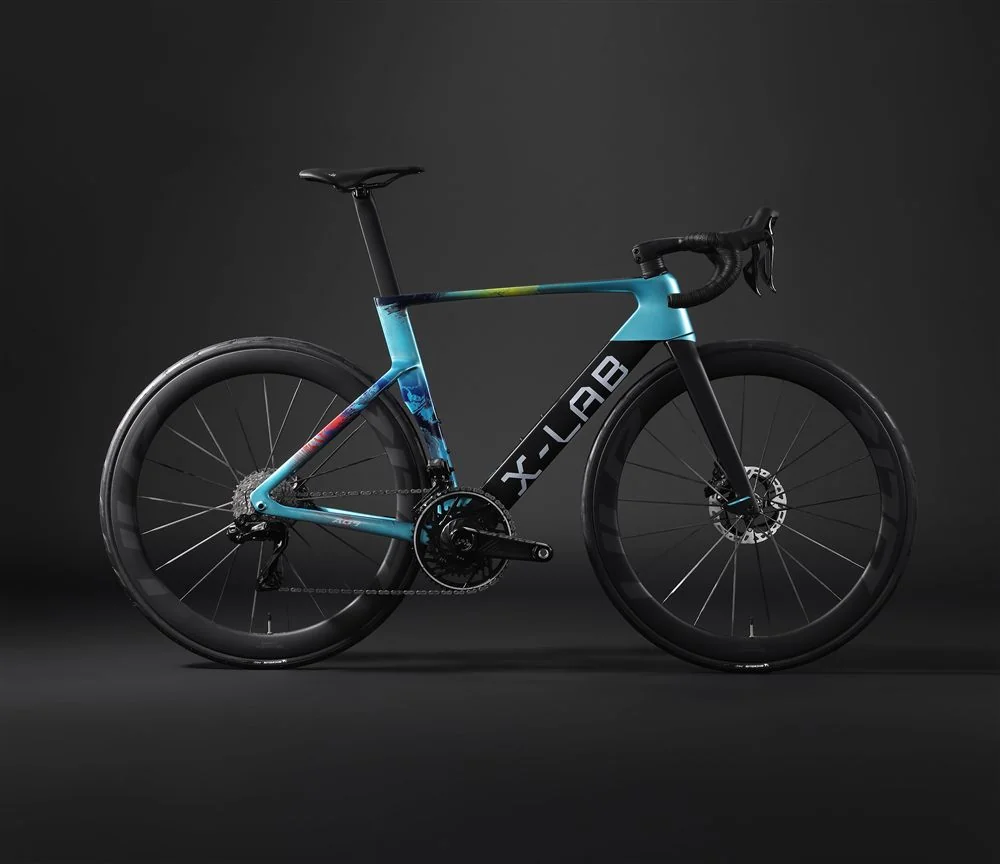 XDS Astana — X-LAB AD9 (First Chinese brand in the WorldTour) |
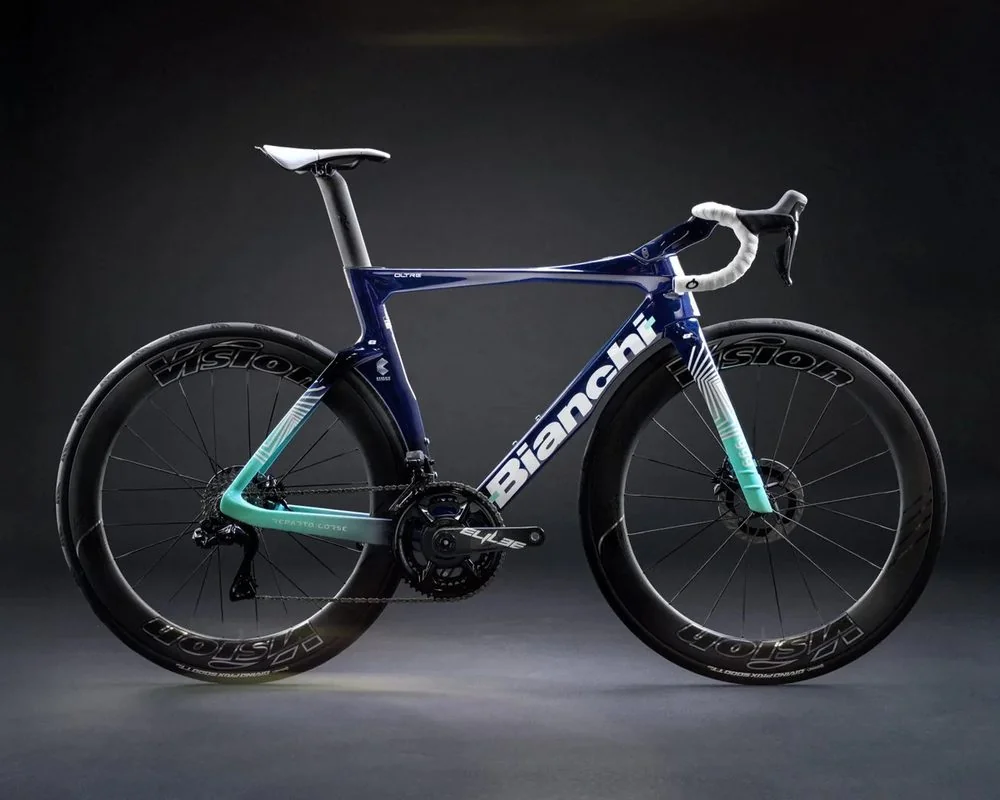 Bahrain Victorious — Bianchi (Switched after nine years on Merida) |
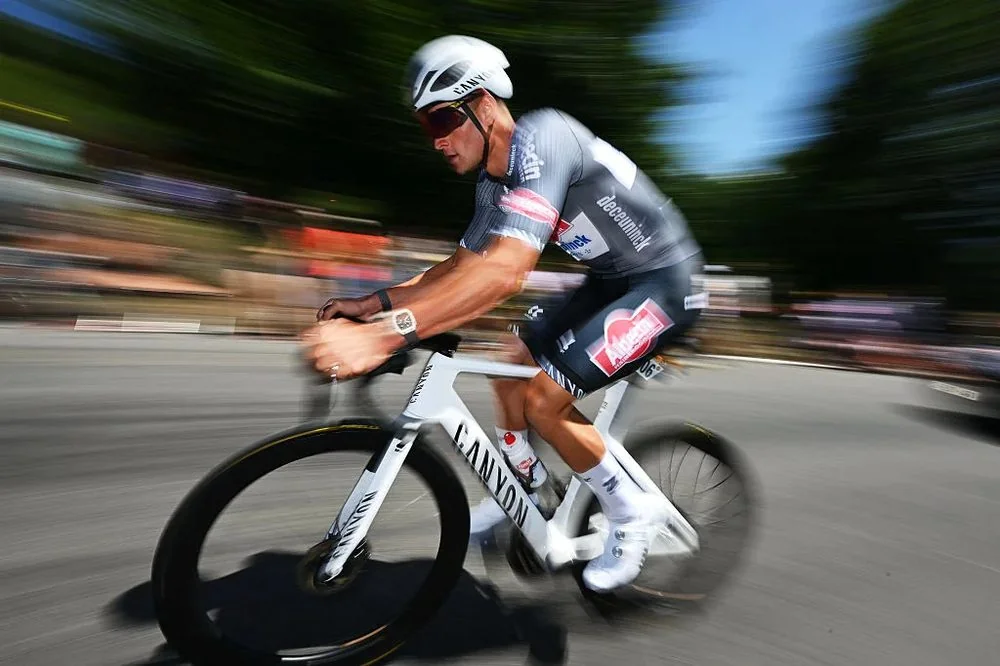 Alpecin–Premier Tech — Canyon Aeroad CFR |
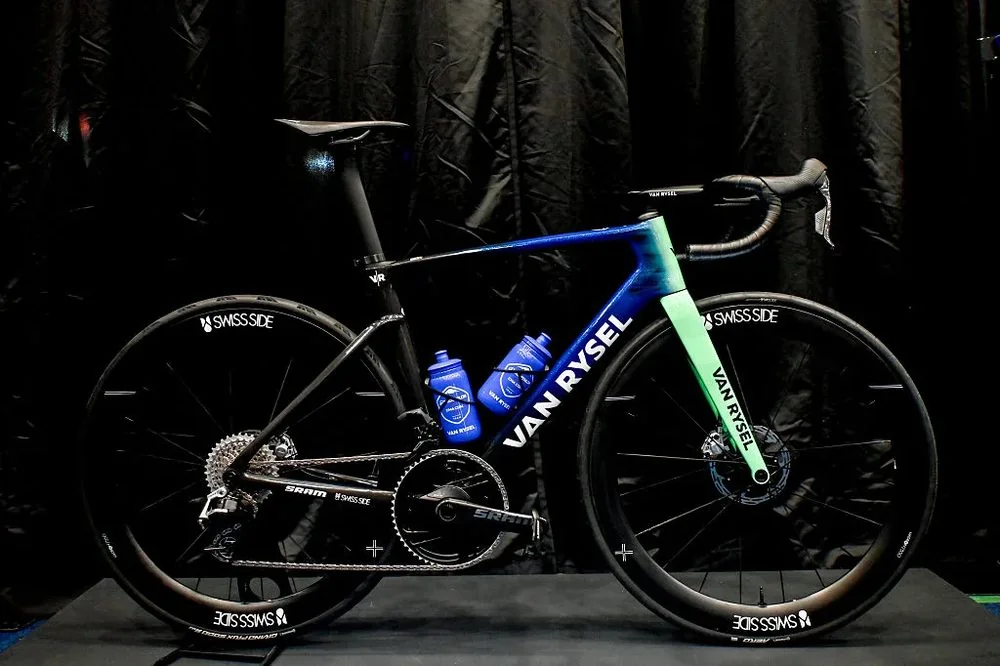 Decathlon CMA CGM — Van Rysel / SRAM |
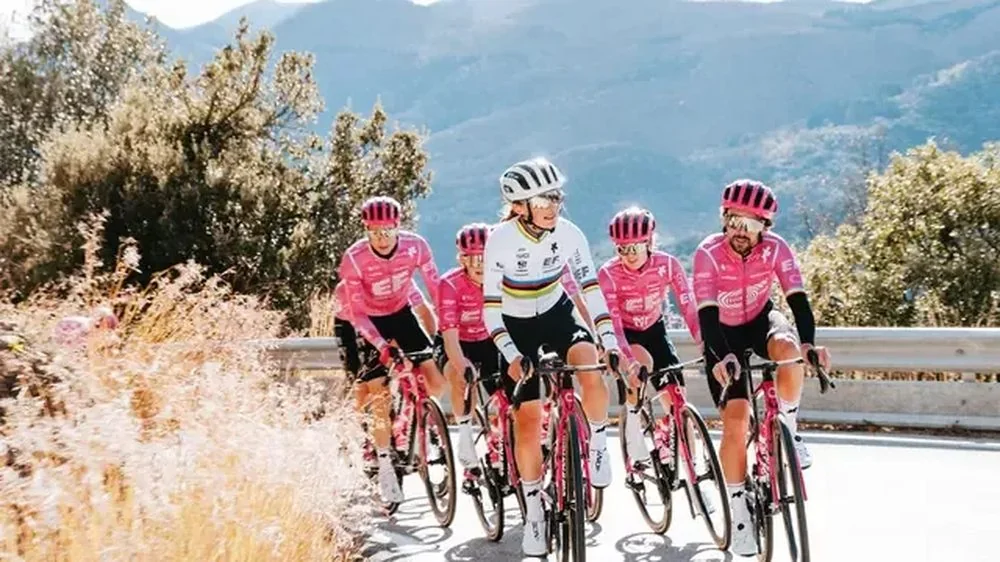 EF Education–EasyPost — Cannondale / SRAM |
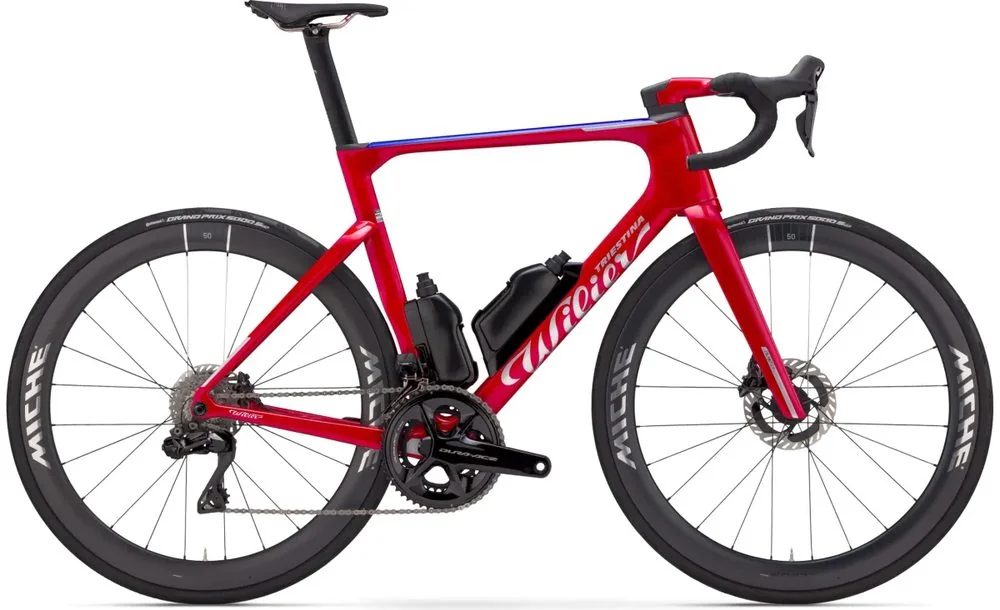 Groupama–FDJ — Wilier Filante SLR ID2 |
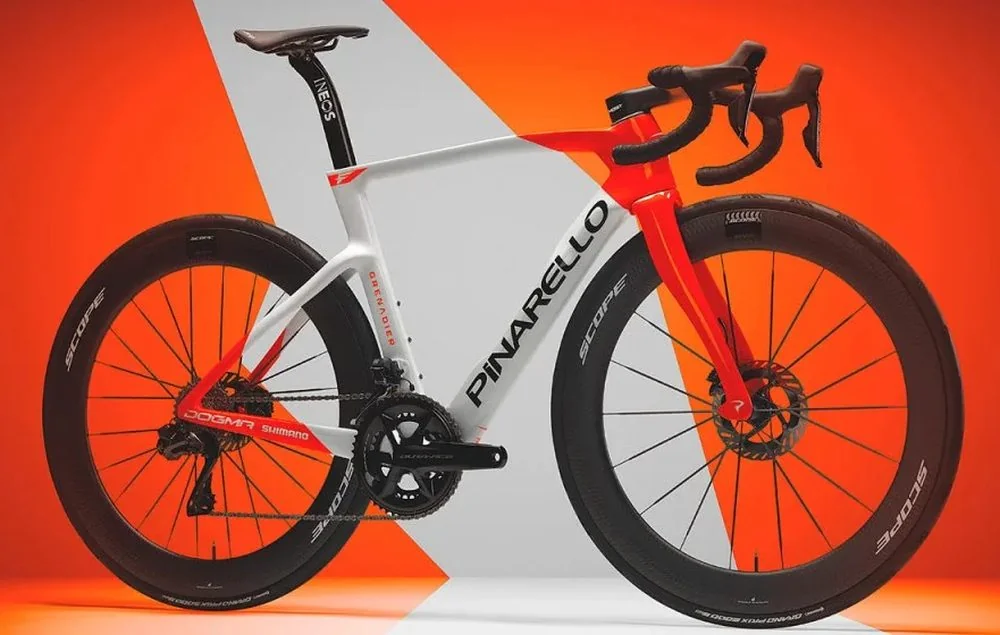 Ineos Grenadiers — Pinarello Dogma F |
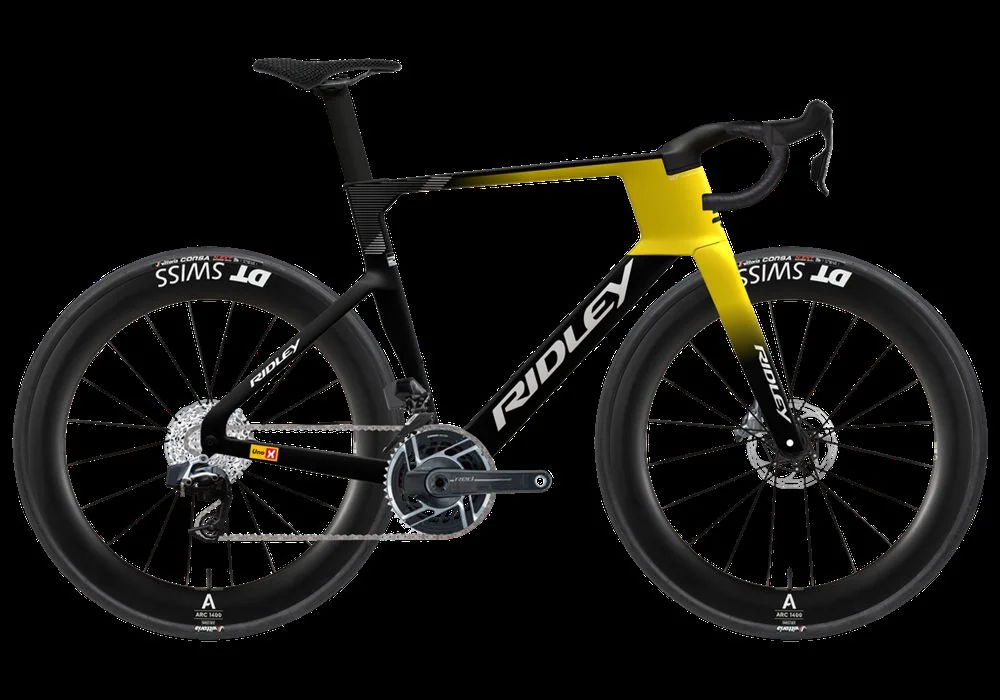 Uno-X — Ridley Noah Fast (Newly promoted WorldTeam) |
UCI ProTeams are the second tier: 16 in 2026, with Cofidis and Pinarello-Q36.5 relegated from the WorldTour. ProTeams race mainly on the UCI Continental Circuits; those high enough in the rankings can receive wildcards to WorldTour and ProSeries events, but their results do not count toward the WorldTour team ranking. The equivalent women’s tier is the UCI Women’s ProTeams, with seven teams in 2026.
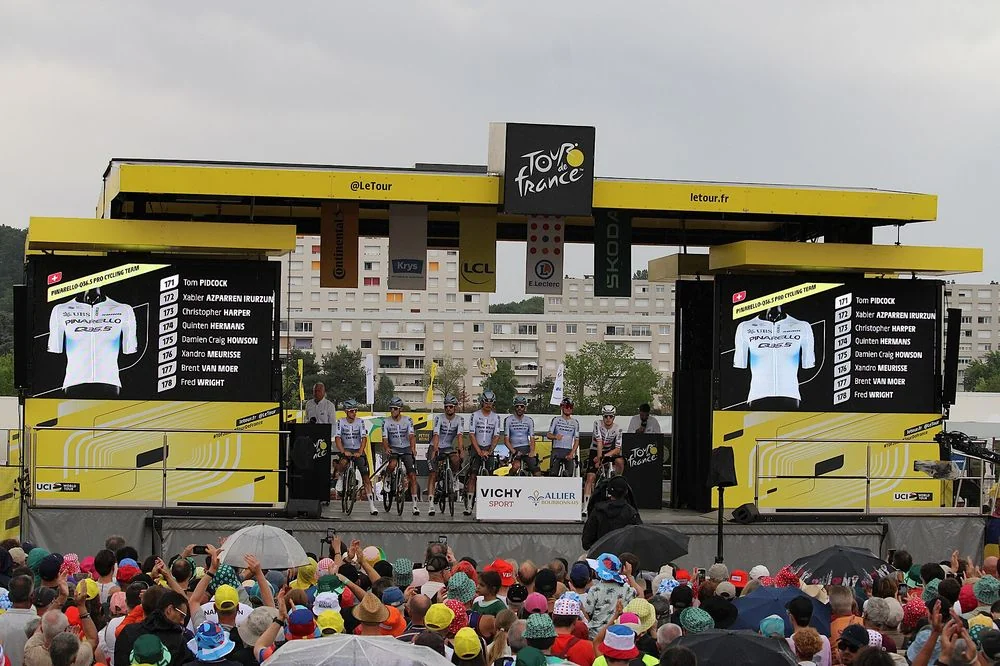
The Pinarello-Q36.5 squad on the start podium at stage 11 of the 2026 Tour de France (Vichy). The team was relegated from the WorldTour to the ProTeam tier and sits right at the threshold.
UCI Continental Teams form the third tier, licensed annually and fluctuating in number from season to season. In 2026, mainland China had 15 UCI-registered men’s and women’s Continental teams (12 men’s, 3 women’s), still among the largest contingents in the world; the Hong Kong Sports Institute team (HKSI) is registered separately. These teams race mainly on the continental calendar, and the best can earn ProSeries wildcards.
Below them sit national teams, regional teams and club teams. They are outside the UCI professional system, yet they are where most riders begin.
2. Race Types and the Shape of a Race
Road racing can be reduced to three types: time trials decided by individual or team effort against the clock, mass-start races, and one-day Classics.
Time Trials: Racing the Clock
In an individual time trial (ITT), riders start at intervals of 30 seconds to two minutes (1:30 at the Olympics) and are forbidden to draft one another. Courses are usually straight and flat, between 5 and 40 km long, and the result depends on a rider’s ability to sustain power over that distance. Placings are decided by time alone.
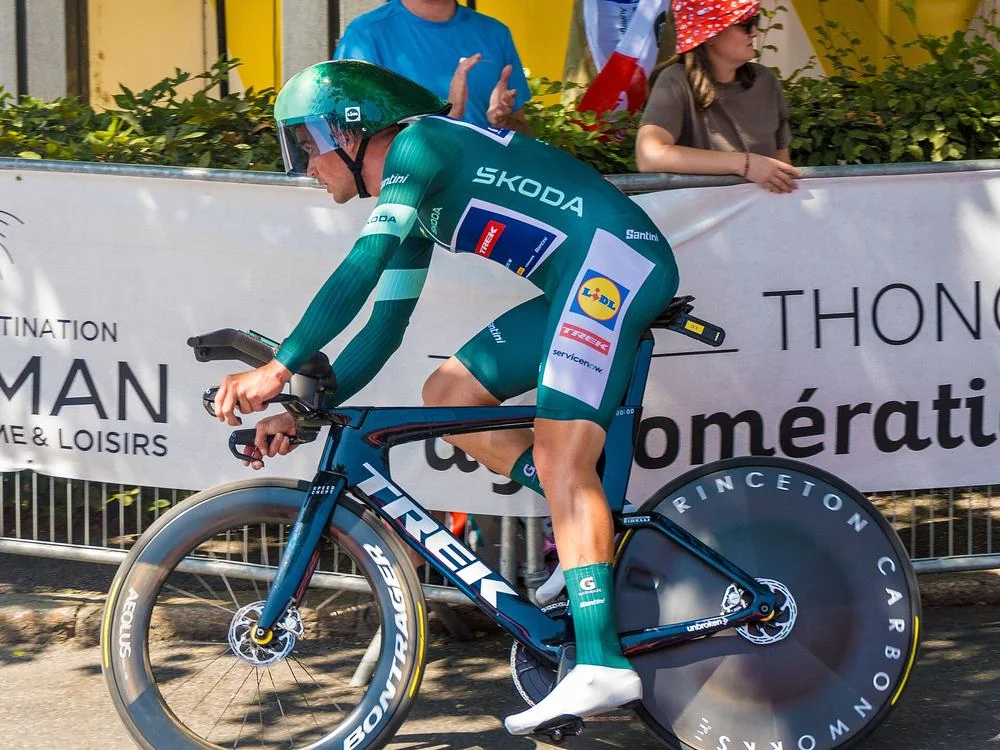
Stage 16 of the 2026 Tour de France at Thonon-les-Bains on the shore of Lake Geneva. Time trial bars sit lower to reduce frontal area.
A team time trial (TTT) starts whole teams at intervals of two to three minutes, with riders taking turns on the front. At the World Championships and the Olympics the format is four riders per team, with the team’s time taken from its third rider.
The 2026 Tour de France altered the traditional format: stage 1 in Barcelona covered 19.6 km with eight riders per team, and the team’s time was taken from its first rider across the line rather than the fourth; individual times were still recorded separately. Visma–Lease a Bike won the stage, and Jonas Vingegaard took the yellow jersey on day one.
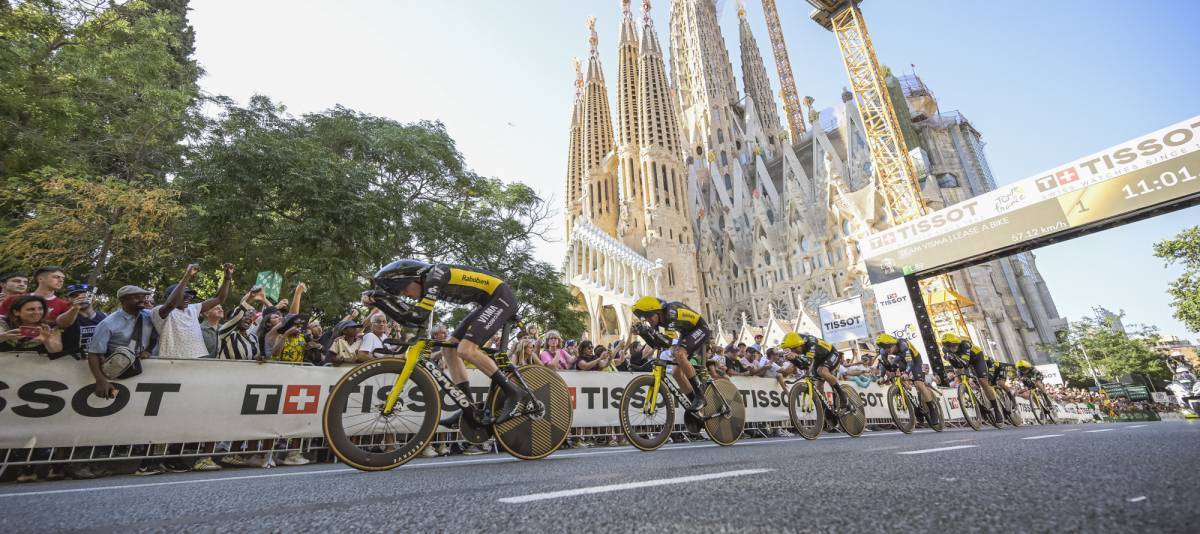
Stage 1 of the 2026 Tour de France: Visma–Lease a Bike pass the Sagrada Família in Barcelona. The tactical core of a TTT is sharing the work to save energy for teammates; formation must also account for wind direction.
Mass-Start Racing: A Game of Position and Patience
The vast majority of stages are mass-start races. Every team sets off together—typically 22 teams of eight riders in a Grand Tour—covering 120 to 200 km in a day, with several climbs along the way. Climbs are graded 4, 3, 2, 1 and HC (Hors Catégorie, the highest).
Mass-start racing divides into one-day and stage races. In a one-day race the first rider across the line wins, with placings converted into points and team results taken from the best-placed rider; a stage race is split into stages, ranked and scored daily, then accumulated, with the rider holding the best aggregate time crowned overall winner (General Classification, GC).
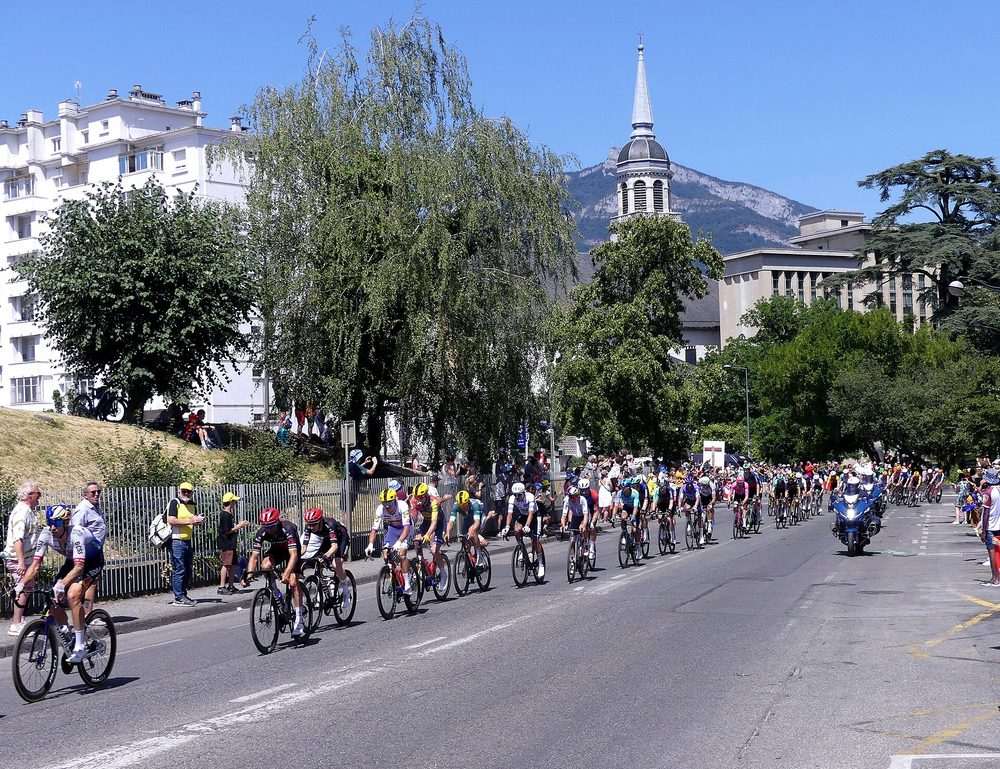
Stage 17 of the 2026 Tour de France: the peloton threads through Chambéry. The “peloton” is the dense main group of dozens to over a hundred riders.
Classics: The Limit of One-Day Racing
The five Monuments are the oldest and hardest one-day races in the WorldTour: Milan–San Remo, the Tour of Flanders, Paris–Roubaix, Liège–Bastogne–Liège and Il Lombardia. Paris–Roubaix is notorious for its consecutive cobbled sectors (pavé), where riders struggle to control their bikes through violent vibration—hence its nickname, “the Hell of the North.”
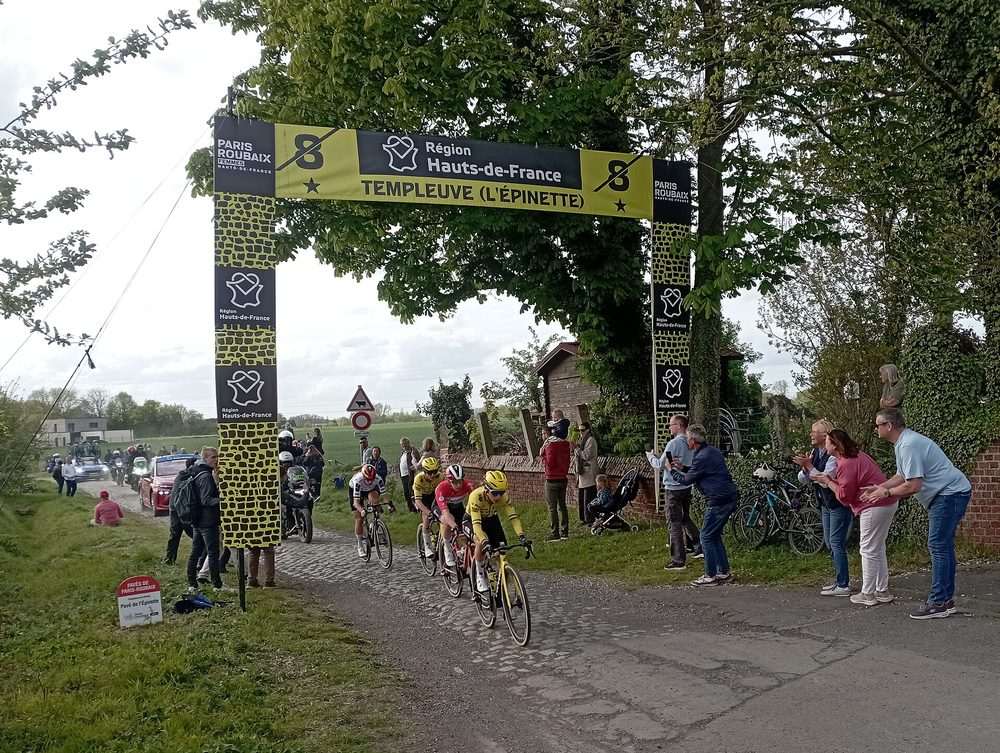
The 2026 Paris–Roubaix Femmes, with riders crossing the cobbles at Templeuve. Dust collects between the stones, and crashes are common on such sectors.
The Tactical Arc of a Stage
After the start, the race usually passes through a relatively controlled phase. Then a rider or small group probes off the front: the attack, or breakaway. It is not blind expenditure of energy but a negotiation over whether the peloton is willing to let them go.
The riders clear of the bunch form the breakaway—known to Chinese fans as the “rabbit.” The peloton, dozens to over a hundred strong, must judge the gap: how far can the break be allowed to go while remaining controllable? Chase too early and you spend energy; chase too late and the win may be gone.
The breakaway is not a free-for-all either. With few riders, they form a pace line: each takes a turn of tens of seconds to a minute or two on the front, then swings off to the back and the next rider takes over. A smooth rotation sustains speed; a ragged one is quickly reeled in. In strong crosswinds the formation angles across the road into an echelon, and riders on the exposed side absorb more wind and burn more energy.
Then comes the chase. Teams seeking control send riders to the front of the peloton, sitting close to the wheel ahead to reduce frontal area—pulling. Those behind exploit the slipstream to save energy—drafting. A group that splits off from the peloton specifically to hunt the break is the chasing group. The rider on the front bears most of the wind, while those drafting save roughly 20–30% of their energy; that is why the rider doing the work usually carries the day’s tactical responsibility. The higher the speed and the tighter the wheel, the greater the aerodynamic benefit.
Broadcast graphics show the time gap between break and chase in real time. When it reaches zero, the break is caught; Chinese fans also say it has been “sucked back.” Unwilling escapees often counter-attack late, or press on alone in a solo move.
With five kilometres to go, the race enters the positioning phase. Teams mass at the front and riders fight for space away from the outside barriers. A sprinter is usually escorted by a lead-out rider who shelters and accelerates them before pulling aside in the final 150–200 metres, like a rocket booster. Then comes the bunch sprint, with dozens of riders crossing the line together and a photo finish if necessary.
Riders who cannot hold the wheel are dropped; on mountain stages, when the gradient bites, the bunch stretches into a long line and may shatter into small groups—what Chinese fans call being “blown up.”
graph LR
  A[Start] --> B[Breakaway forms]
  B --> C[Peloton controls the gap]
  C --> D{Gap controllable?}
  D -->|Yes| E[Caught: bunch sprint]
  D -->|No| F[Break contests the win: solo or small-group sprint]
Two further terms matter in stage races. The queen stage is the hardest mountain day of a three-week race—the most climbing, the steepest gradients, and often the stage that decides the yellow jersey. The processional is the ceremonial start to the final day into Paris, when the peloton rolls at low speed for photographs, champagne and conversation before the racing begins on the Champs-Élysées; some Chinese races also use the term for a ceremonial ride before the official start. Neither counts for time.
Rider Roles
A team of eight has a clear division of labour. The leader (or GC contender) is the focus of the overall classification, and the team’s resources are bent toward him. Domestiques do the support work: pulling, chasing, fetching bottles, sheltering. The lead-out rider provides the final acceleration before a sprint. Strong climbers form the “mountain train,” escorting the leader to the last climb of the day before dropping away—not a failure, but a job completed.
A team also carries time trial specialists, who can sustain power alone on the flat and often control the race; a road captain, usually an experienced veteran who adjusts tactics on the road; and water carriers, who shuttle between the team car and the peloton with bidons.
Time Cuts and Race Discipline
Not every dropped rider finishes. Each stage has a time limit: on flat stages the winner’s time plus 5–12%, with the allowance rising with speed; on mountain stages it widens to 9–19%; time trials have a flat 30% allowance. Riders outside the limit are disqualified (DSQ) for the day.
Officials retain discretion. In heavy rain, mass crashes or road closures the limit can be adjusted, and riders delayed through no fault of their own may be reinstated—at the cost of losing all points earned that day.
The rulebook constrains behaviour in detail: helmets must be worn throughout; race numbers and timing chips must be fixed in the prescribed positions; a sprinter may not deviate suddenly and block another rider, a judgement that sparks controversy every year and can bring relegation, a time penalty or disqualification; riders may not hold onto team cars or sit behind motor vehicles for long periods; feeding is permitted only in designated zones, and in principle not in the final 20 km except in extreme heat; bidons and wrappers must not be discarded, on pain of points deductions and fines; race radios are allowed in the WorldTour but for receiving race information only.
Penalties escalate: warning, fine, time penalty, relegation, disqualification, and finally suspension.
3. Classifications and Leader’s Jerseys
Road races run several rankings at once, each with its own arithmetic. The four leader’s jerseys are the visible expression of those rankings on the riders’ backs.
Yellow Jersey: General Classification (GC)
The general classification is the simplest to calculate: add up each rider’s stage times, and the lowest total wears the yellow jersey (maillot jaune). To encourage attacking, the top three on a stage receive time bonuses: 10 seconds for first, 6 for second, 4 for third. There are no bonuses in time trials, and 2026 also removed the intermediate bonus sprints.
Exact ties are extremely rare; if they occur, the tie is broken by hundredths in the time trial, then by the sum of stage placings, and finally by the placing on the last stage.
Green Jersey: Points Classification
The points classification is not calculated on time but on placings. Riders score at each stage finish, and also at intermediate sprints (IS).
The rules changed for 2026: the winner of a flat stage now scores 70 points instead of 50, and scoring places expanded from 15 to 18. The official rationale was to favour pure sprinters, after Tadej Pogačar—a GC rider—finished second in the 2025 green jersey standings, an unusual sight in Tour history.
| Stage type | Finish points (from 1st) |
|---|---|
| Flat (top 18) | 70 / 50 / 40 / 35 / 30 / 26 / 24 / 22 / 20 / 18 / 16 / 14 / 12 / 10 / 8 / 6 / 4 / 2 |
| Hilly (top 15) | 50 / 30 / 20 / 18 / 16 / 14 / 12 / 10 / 8 / 7 / 6 / 5 / 4 / 3 / 2 |
| Mountain and individual time trial (top 15) | 20 / 17 / 15 / 13 / 11 / 10 / 9 / 8 / 7 / 6 / 5 / 4 / 3 / 2 / 1 |
| Intermediate sprint (top 15) | 25 / 20 / 16 / 14 / 12 / 10 / 9 / 8 / 7 / 6 / 5 / 4 / 3 / 2 / 1 |
| Team time trial | No green jersey points |
Ties are broken by stage wins, then intermediate sprint wins, then GC position.
The UCI also operates a separate UCI World Ranking, scoring by race tier and placing and used for team rankings, promotion and relegation, and Olympic quota allocation; it does not affect the jerseys within a single race.
Polka-Dot Jersey: King of the Mountains (KOM)
The mountains classification is scored by placings at the top of categorised climbs. Climbs are graded in five levels: HC is the highest, followed by categories 1 to 4; the harder the climb, the more points.
| Climb category | Points (from 1st) |
|---|---|
| HC (highest) | 20 / 15 / 12 / 10 / 8 / 6 / 4 / 2 (top 8) |
| Category 1 | 10 / 8 / 6 / 4 / 2 / 1 (top 6) |
| Category 2 | 5 / 3 / 2 / 1 (top 4) |
| Category 3 | 2 / 1 (top 2) |
| Category 4 | 1 (first only) |
A climb’s category is decided by length, average gradient, altitude and its position in the stage; the same mountain can be reclassified from one year to the next. Ties are broken by the number of HC climbs won, then category 1, then category 2.
White Jersey, Team Classification and Combativity
The white jersey (maillot blanc) goes to the best young rider: those born on or after 1 January 2001 and aged 25 or under are ranked separately on GC, and the leader wears white.
The team classification adds the times of a team’s three best riders on each stage and accumulates them to Paris.
The combativity award is decided by a jury. One rider is chosen as the most aggressive on each road stage (time trials and the final stage excepted) and wears a red number the next day; at the end of the race a Super Combativity Award is also given.
The Four Jerseys of the 2026 Tour de France
The 2026 Tour de France started in Barcelona on 4 July and finished in Paris on 26 July, covering 3,320.7 km as the 113th edition.
| Jersey | Winner | Team |
|---|---|---|
| Yellow (overall) | Tadej Pogačar | UAE Team Emirates XRG |
| Green (points) | Mads Pedersen | Lidl–Trek |
| Polka dot (mountains) | Richard Carapaz | EF Education–EasyPost |
| White (young rider) | Isaac del Toro | UAE Team Emirates XRG |
Pogačar sealed his fifth Tour title on stage 21 in Paris, equalling Jacques Anquetil, Eddy Merckx, Bernard Hinault and Miguel Indurain; Pedersen became the first Dane to win the green jersey; Carapaz won solo on Alpe d’Huez on stage 20 and took his second mountains title (the first was in 2024); Del Toro wore white for the first time.
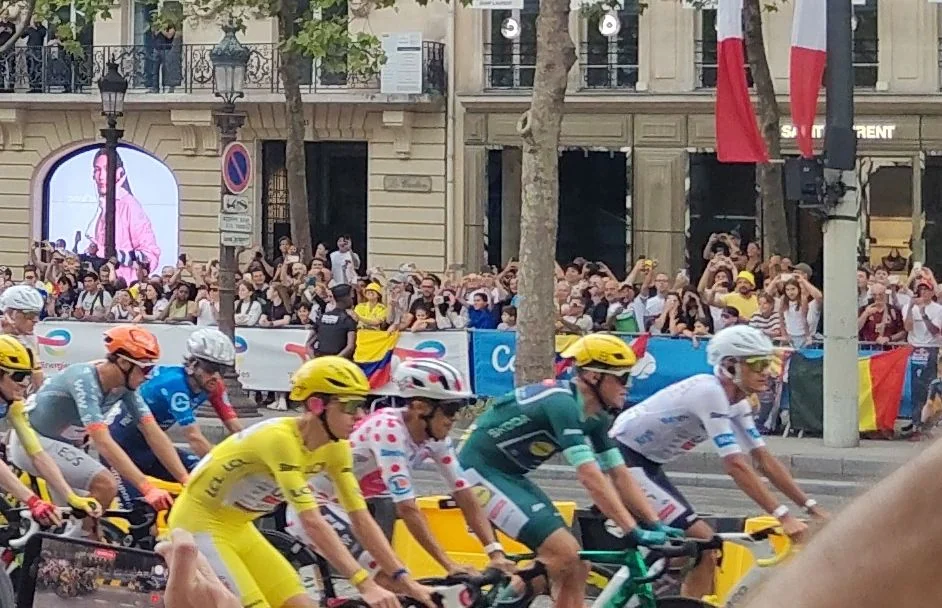
Stage 21 of the 2026 Tour de France on the Champs-Élysées. Yellow jersey Pogačar, polka-dot Carapaz, green jersey Pedersen and white jersey Del Toro ride together. The colours and patterns of the four jerseys have changed little over the years.
4. Course Infrastructure and Race Vehicles
Scoring Points: IS and KOM
Two kinds of scoring point sit on the course. The IS (Intermediate Sprint) awards points toward the green jersey; the KOM (King of the Mountains) point awards points toward the polka-dot jersey. Television commentary such as “two kilometres to the HC climb” refers to these locations.
Stages 9 and 20 of the 2026 Tour de France offer samples of a hilly and a mountain day respectively.
Stage 9 ran from Malemort to Ussel over 154.6 km, a hilly route. It had one sprint point at Beynat (km 13.9, 399 m) and four categorised climbs: the category 3 Côte de Naves (2.3 km, 7.4%), the category 2 Suc au May (3.8 km, 7.7%), the category 3 Côte de la Croix du Pey (4.8 km, 6%) and the category 4 Mont Bessou (900 m, 7.3%).
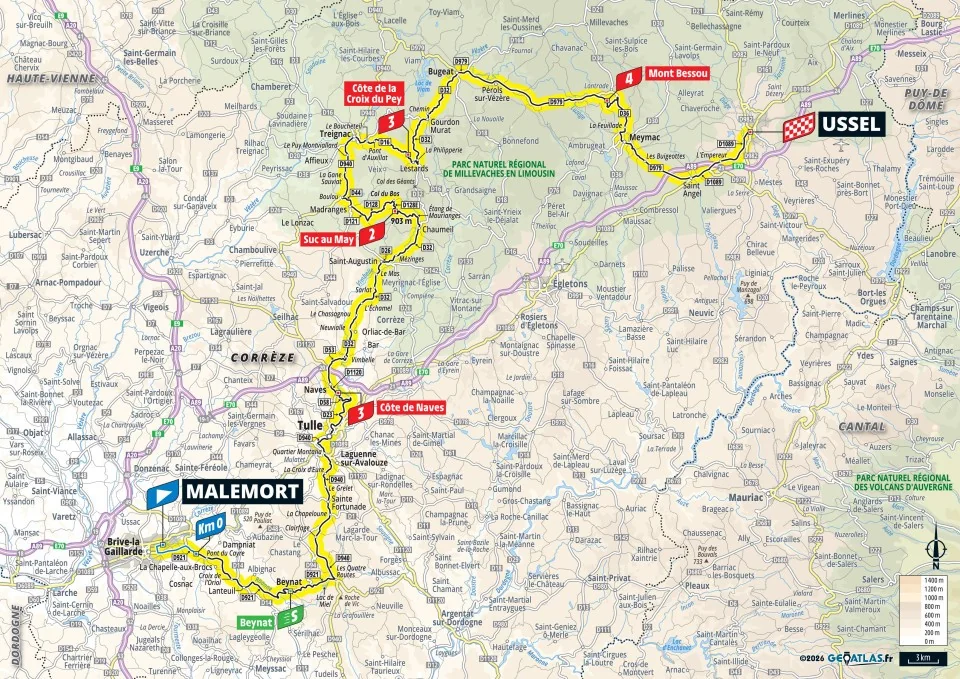
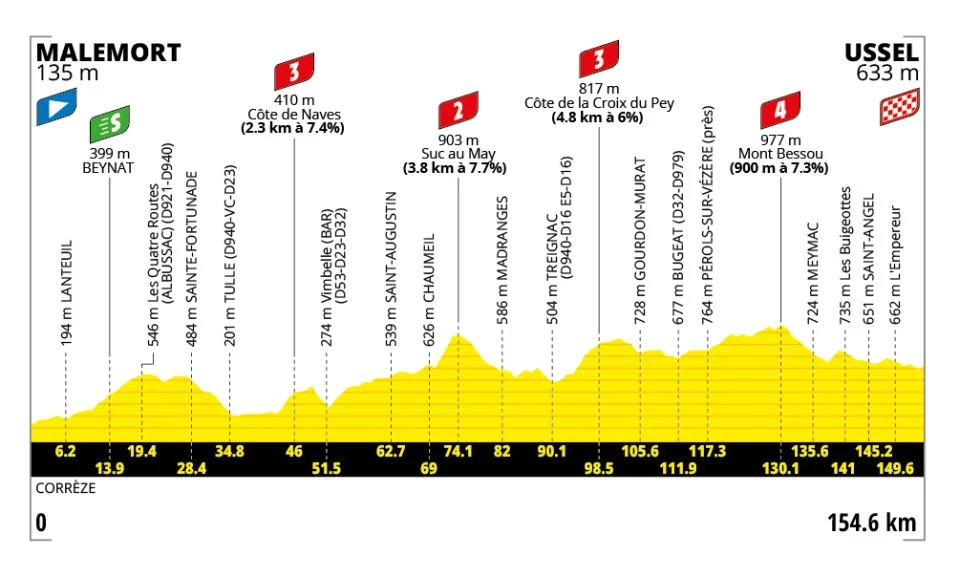
Stage 20 was a mountain stage from Le Bourg d’Oisans over 170.9 km to Alpe d’Huez. It included four HC climbs: the Col de la Croix de Fer (24 km, 5.2%), the Col du Galibier (17.7 km, 6.9%, the race’s highest point at 2,642 m and the site of the Henri Desgrange memorial), the Col de Sarenne (12.8 km, 7.3%) and the finish at Alpe d’Huez (13.8 km, 8.1%); the Col du Télégraphe in between is category 1. The sprint point was at Saint-Julien-Mont-Denis (km 49.9).
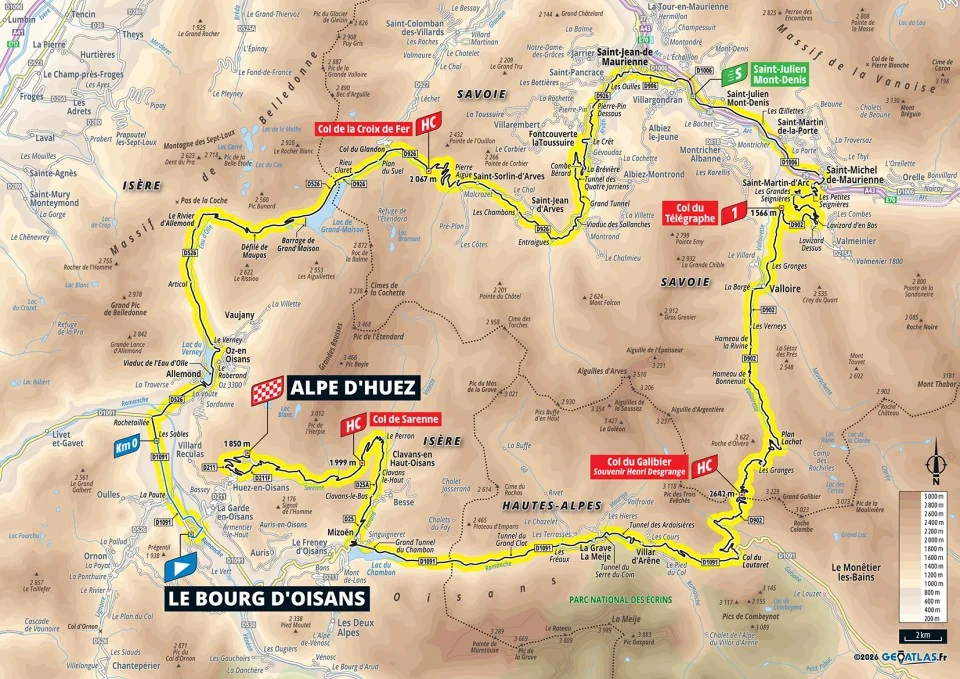
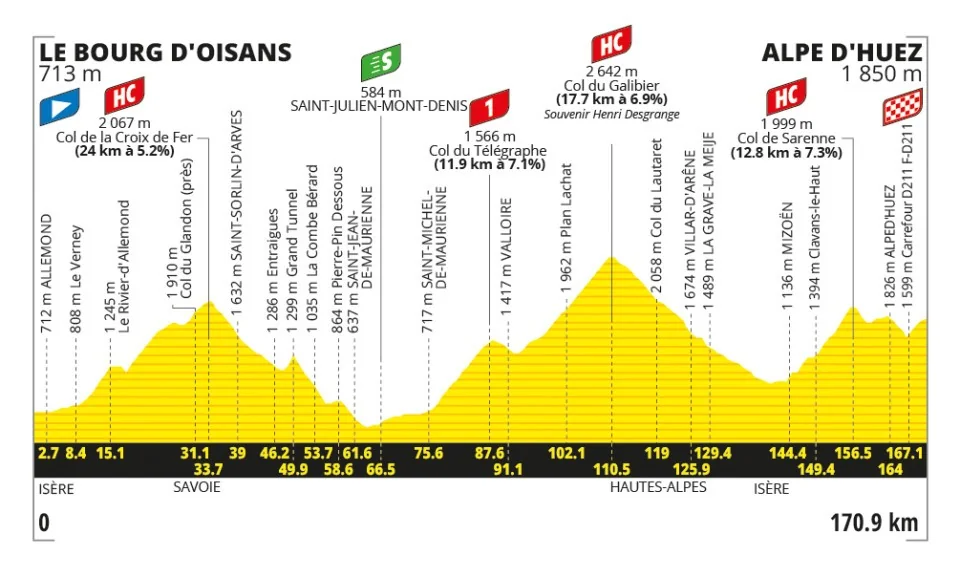
Maps and elevation profiles from the official Tour de France site (© ASO / Géoatlas). Red triangles mark categorised climbs, green flags mark sprint points, and the figures along the bottom are distance markers.
Signs
At 40–50 km/h, riders need advance warning of corners, gradients and feed zones. Roadside signs do that job: distance, gradient, corner direction and feed area each have their own format.
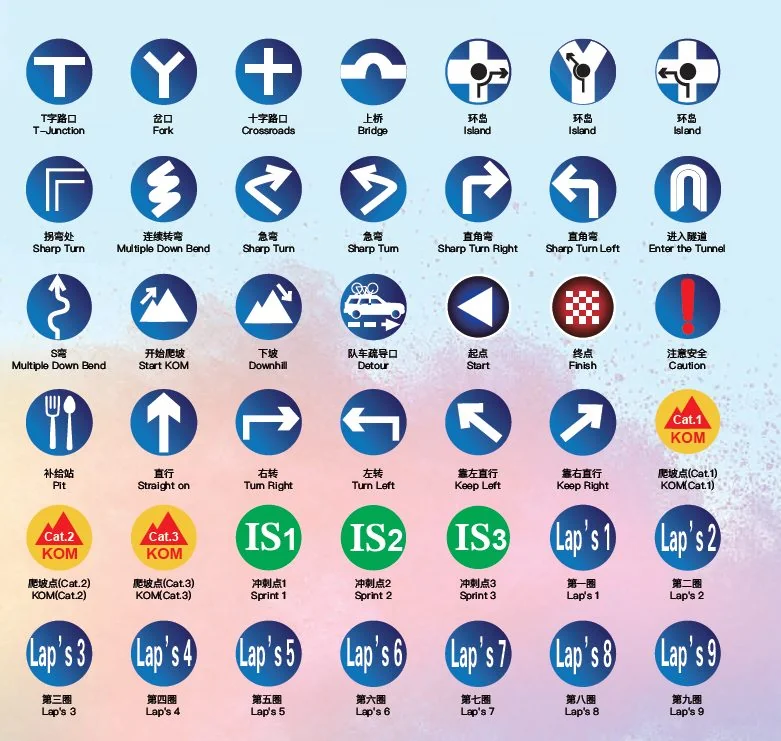
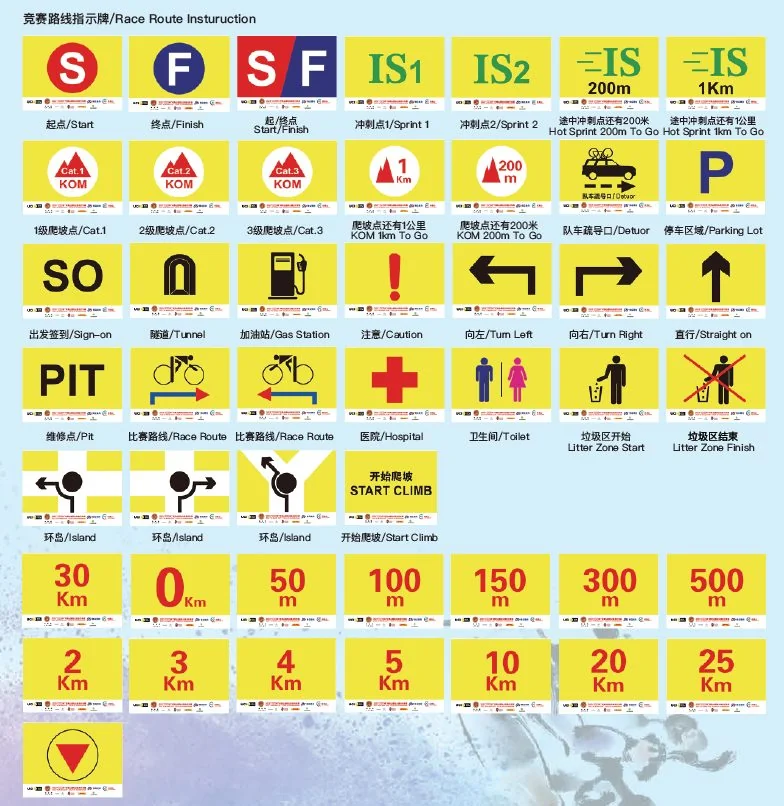
The Race Convoy
At major races the vehicle convoy is often longer than the field itself. From the leading car to the final motorcycle, the order runs roughly as follows:
Lead car → VIP car → commissaire C4 → media car → technical officials and neutral service → assistant director → security motorcycles → race director → commissaire C2 → peloton → chief commissaire → organisation motorcycle → medical car → team cars → commissaire C5 → commissaire C3 → VIP car → neutral equipment → ambulance → broom wagon → sweeper motorcycle
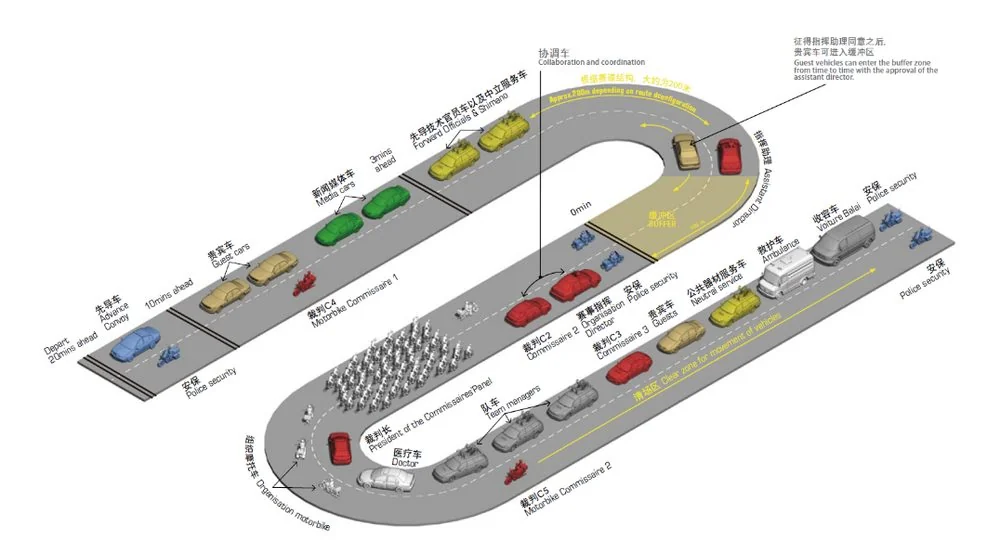
| Vehicle | Function |
|---|---|
| Shimano neutral service car | Provides neutral equipment (wheels, bikes) to any rider |
| Team car | Follows its own riders with feed, equipment and tactical direction |
| Race motorcycle team | Refereeing, filming, guiding and security on two wheels |
| Team car feeding | Hands up bottles and gels from the team car |
| Motorcycle commissaire (blackboard) | Officials on motorcycles who signal stage information and time gaps on a board |
| Chief commissaire’s car | Carries the race referee, responsible for decisions and penalties |
| Race director | Vehicle of the race director, coordinating race operations |
| Radio monitoring | Monitors race radio communications |
| Signal support | Television and communications signal support |
| Emergency communications | Emergency communications backup |
5. China’s Place in Road Cycling
Races
China now hosts WorldTour-level racing. The Tour of Guangxi is a men’s 2.UWT, whose sixth edition ended on 18 October 2026, and also includes a women’s WorldTour race; the Tour of Chongming Island is a women’s 2.WWT. Below them sit the ProSeries events: the Tour of Qinghai Lake, the Tour of Taihu Lake and the Tour of Hainan, all 2.Pro. The Continental tier is larger still, including the “Sun Hung Kai Properties” Hong Kong Challenge (1.1), the Tour de Taiwan (2.1), Pingtan (1.2), the Tour of Huangshan (2.2), the Tour of Poyang Lake (2.2), the Tour of Binzhou (2.2) and the Trans-Himalaya (2.2).
Teams
The Chinese Continental landscape shifted noticeably for 2026. According to the UCI list published in mid-February 2026, mainland China had 12 registered men’s Continental teams and 3 women’s teams, 15 in total; the men’s count was down three from 15 in 2025. The main changes: China Chermin was newly formed with backing from Meitan, coached by Wang Yuhang and drawing riders from the Hunan and Inner Mongolia teams and the former Anta-Mentech squad; Wheeltop–Rotor–Chengdu added WheelTop and Kexia as title sponsors on the existing Chengdu base; Bodywrap LTWOO continued with Henan as its core; Shenzhen Xidesheng registered as Gineyea-Xidesheng; The Joyrun & Hurricane registered under that name; Qinghai Tianyoude completed a generational handover, with Wang Jiancai, Li Zisen and Zhang Zhishan moving into coaching; Pingtan International Tourism Island and Shenzhen Gong were still completing registration in mid-February, while Pardus and Wuzhishan 1867 were absent from the published list.
The table below ranks the teams by 2026 points; points and world positions are as of 19 October 2026 and may still shift slightly before the season ends:
| China rank | Team | 2026 points | World rank |
|---|---|---|---|
| 1 | Li Ning Star | 473 | 46 |
| 2 | China Anta - Mentech | 252 | 60 |
| 3 | Camp Cycling Team | 106 | 101 |
| 4 | Shenzhen Gineyea - Xidesheng | 92 | 107 |
| 5 | FNIX - SCOM - Hengxiang | 67 | 119 |
| 6 | Wheeltop - Rotor - Chengdu | 65 | 121 |
| 7 | China Chermin | 62 | 124 |
| 8 | Huansheng - Vonoa - Taishan Sport | 55 | 134 |
| 9 | The Joyrun & Hurricane | 22 | 168 |
| 10 | Bodywrap LTWOO (BDR) | 1 | 202 |
| 11 | Giant - Champion System | 0 | — |
| 12 | Tianyoude | 0 | — |
Data as of 19 October 2026. Points: CyclingRanking 2026 team standings (aggregated on the UCI points basis; teams on 0 points are not listed there and are shown as 0). Registration and changes: UCI 2026 published list, Biketo report of 25 February 2026, Xinhua report on Tianyoude of 8 July 2026.
The three women’s Continental teams are Bodywrap LTWOO, Liv and Li Ning Star; the Xidesheng women’s team was still in the publication process in mid-February, and women’s team points are not included in the table above.
Governance
The system runs from the top down: the UCI sets global rules; the Cycling and Fencing Administrative Centre of the General Administration of Sport of China is the administrative authority; at industry level there are the China Bicycle Association, the China National Light Industry Council and the Chinese Cycling Association; locally there are culture, tourism and sports bureaus and cycling associations; and the China International Bicycle Fair handles the trade show.
Virtual Cycling: Another Arena
A smart trainer connected to a screen can also produce a world champion. The UCI has held the Cycling Esports World Championships since 2020; the 2026 edition takes place on the MyWhoosh platform, with junior and masters categories and “sprint checkpoints” on course that force riders to sprint flat out at set points and redistribute their energy.
Virtual racing has no crosswinds, no descending technique and no team cars, so tactics compress into two variables: watts per kilogram (W/kg) and pacing. Its value to road racing is that riders can maintain form through winter, rain and injury rehabilitation; for ordinary enthusiasts it is one of the few formats in which they can race against professionals. The UCI announcement is here: 2026 Cycling Esports World Championships.
Glossary
Grouped by theme; each entry follows the pattern “Chinese term (English, abbreviation): definition” for easy searching, copying and citation.
Races and Organisations
- Grand Tour (大环赛): Usually the Tour de France, Giro d’Italia and Vuelta a España—three-week stage races with overall, points, mountains, young rider and team classifications.
- Monument (五大古典赛): The five oldest and most prestigious one-day races in the WorldTour: Milan–San Remo, the Tour of Flanders, Paris–Roubaix, Liège–Bastogne–Liège and Il Lombardia.
- Classic (古典赛): The general term for one-day road races, often featuring cobbles, short steep climbs or other regional difficulties.
- Stage Race (多日赛): An event made up of several stages, with the overall won on aggregate time or points.
- One-day Race (单日赛): A race completed in a single day, decided by finishing position.
- Mass Start (大组赛): A race in which all riders start together, decided by finishing position or aggregate time—as opposed to a time trial.
- Processional (荣誉骑行): The ceremonial ride before the racing begins on the final stage of a stage race; it does not count for time.
- UCI WorldTour (世巡赛, UWT): The highest tier of UCI road racing, contested mainly by WorldTeams.
- UCI ProSeries (Pro 系列赛): The second tier, below the WorldTour and above the Continental circuit.
- UCI Continental (洲际赛): The third tier of UCI road racing, contested mainly by Continental teams.
- Wildcard (外卡): An invitation from an organiser to a team that has not qualified automatically.
- Relegation (降级): A team dropping out of a higher tier because it has not met points or financial conditions.
Riders and Tactics
- Leader / GC Contender (主将): The rider a team is built around in pursuit of the overall or another major prize.
- Domestique (副将): A rider who supports the leader by pulling, chasing, fetching bottles and sheltering.
- Rouleur (平路型车手): A rider who can sustain a high, steady effort on flat and rolling terrain and control the bunch.
- Grimpeur (爬坡手): A lighter rider who climbs efficiently and excels on mountain stages.
- Puncheur (短坡型车手): A rider suited to short, steep climbs and late attacks, often seen in the Classics.
- Sprinter (冲刺手): A rider who excels at high-speed finishes and contests stage wins.
- Lead-out (带冲手): A teammate who shelters and accelerates the sprinter before pulling aside in the finale.
- Time Trialist (计时赛手): A rider who can hold high power alone against the clock and excel in time trials.
- Road Captain (场上队长): An experienced rider who adjusts tactics during the race and speaks for the team to officials.
- Peloton (主集团): The main group containing most of the riders in a race.
- Breakaway (突围集团): A small group or lone rider clear of the peloton.
- Chasing Group (追击集团): A group that has left the peloton specifically to pursue the break.
- Echelon (横风梯队): An angled formation used in crosswinds to shelter in the wind shadow and reduce drag.
- Drafting (跟风): Riding close behind another rider to shelter in their slipstream.
- Mountain Train (山地火车): A line of strong climbers used to raise the pace on a mountain stage and wear down rivals.
- Solo (单飞): An attack in which a rider goes clear alone and rides to the finish by themselves.
- Bunch Sprint (集团冲刺): A large group sprinting for the line, with placings decided by milliseconds.
Results and Rules
- General Classification (总成绩, GC): The overall ranking by accumulated stage time; the leader wears yellow.
- Points Classification (冲刺积分): The ranking by points at finishes and intermediate sprints; the leader wears green.
- King of the Mountains (爬坡积分, KOM): The ranking by points at categorised climbs; the leader wears polka dot.
- Young Rider (年轻车手): A separate overall ranking restricted by age; the leader wears white.
- Team Classification (车队榜): A team ranking based on the accumulated times of its top three riders each stage.
- Combativity Award (敢斗奖): Awarded to the most aggressive rider of the day; a Super Combativity Award is given at the end of the race.
- Time Bonus (减秒): Seconds deducted from a rider’s overall time for a high stage placing.
- Time Cut (关门时间): The maximum time allowed to finish a stage; riders outside it are disqualified for the day.
- Disqualification (取消资格, DSQ): Removal from a stage or the race for exceeding the time limit or a serious infringement.
- Intermediate Sprint (途中冲刺点, IS): A scoring point mid-stage that counts toward the points classification.
- Hors Catégorie (最高级爬坡, HC): The hardest and most heavily rewarded climb category.
- UCI Points (UCI 积分): Points awarded by race tier and placing, used for team rankings, promotion and relegation, and Olympic quotas.
Equipment and Course
- Individual Time Trial (个人计时赛, ITT): A time trial in which riders start alone and are ranked by time.
- Team Time Trial (团体计时赛, TTT): A time trial in which teams start together and are timed by a prescribed placing.
- Pavé (鹅卵石路段): The cobbled sectors of races such as Paris–Roubaix—brutal under wheel and demanding on equipment and handling.
- Queen Stage (皇后赛段): The hardest mountain stage of a stage race, usually decisive for the overall.
- Feed Zone (补给区): A designated section where teams may hand bottles and food to riders.
- Neutral Service (中立器材服务): Equipment and mechanical support provided by the race for all teams.
- Team Car (队车): The support vehicle that follows a team with feed, spare equipment and tactical instructions.
- Motorcycle Commissaire (白板裁判): An official on a motorcycle who signals time gaps and race information on a board.
- Broom Wagon (收容车): The support vehicle at the tail of the race that picks up riders unable to continue or outside the time cut.
- Bidon (水壶): A rider’s water bottle, which must not be discarded indiscriminately during a race.
- Commissaire (裁判): The official responsible for applying the rules and judging infringements and results.
Sources
Data checked as of 19 October 2026; regulations are adjusted slightly each year, so the current edition prevails. References (all accessed 19 October 2026):
- Union Cycliste Internationale. Allocation of the 14 UCI Women's WorldTour licences and 18 UCI WorldTour licences[EB/OL]. (2025-12-10)[2026-10-19]. https://www.uci.org/pressrelease/allocation-of-the-14-uci-womens-worldtour-licences-and-18-uci-worldtour/6QRootu0WfaZVcXXJVQerE.
- BikeRadar. 2026 WorldTour bikes: the complete list[EB/OL]. [2026-10-19]. https://www.bikeradar.com/features/pro-bike/worldtour-bikes.
- Amaury Sport Organisation. Official route of the 2026 Tour de France[EB/OL]. [2026-10-19]. https://www.letour.fr/en/overall-route.
- Amaury Sport Organisation. 2026 Tour de France regulations: time bonuses, classifications, combativity, points, KOM and maximum time[EB/OL]. [2026-10-19]. https://cyclingpro.net/spaziociclismo/tour-2026/regolamento-tour-de-france-2026-abbuoni-classifiche-combattivita-punti-gpm-tempo-massimo/.
- Cyclism'Actu. Tour de France: un nouveau barème du maillot pour stopper Tadej Pogačar[EB/OL]. (2026-06-20)[2026-10-19]. https://www.cyclismactu.net/news-tdf-route-tour-de-france-un-nouveau-bareme-du-maillot-pour-stopper-tadej-poga-ar-94351.html.
- CyclingRanking. 2025 Team Ranking[EB/OL]. [2026-10-19]. https://www.cyclingranking.com/teams/2025.
- Union Cycliste Internationale. UCI and MyWhoosh reveal key dates, new locations and updated qualification pathway for 2026 UCI Cycling Esports World Championships[EB/OL]. [2026-10-19]. https://www.uci.org/pressrelease/uci-and-mywhoosh-reveal-key-dates-new-locations-and-updated-qualification-pathway-for-2026-uci-cycling-esports-world-championships/6Jn9pgoAN4GILyEPw4Tv9k.
- Wikimedia Commons. Race photographs[EB/OL]. [2026-10-19]. https://commons.wikimedia.org/. CC BY-SA; retain the original author attribution when reusing.
- BikeRadar; team websites. 2026 team bike photographs[EB/OL]. [2026-10-19]. https://www.bikeradar.com/features/pro-bike/worldtour-bikes.
- Amaury Sport Organisation; Géoatlas. 2026 Tour de France stage 1 team time trial photograph, stage 9 and 20 route maps and elevation profiles[EB/OL]. [2026-10-19]. https://www.letour.fr/. © ASO / Géoatlas.
- WowBlue Culture Technology Co., Ltd. Basic introduction to cycling races and products[R]. 2024-11: 17-50.
- Biketo. February domestic news: China at the Asian Championships, progress on UCI registration for domestic Continental teams[EB/OL]. (2026-02-25)[2026-10-19]. https://www.biketo.com/industry/55746.html.
- CyclingRanking. Team Ranking 2026[EB/OL]. [2026-10-19]. https://www.cyclingranking.com/teams/2026.